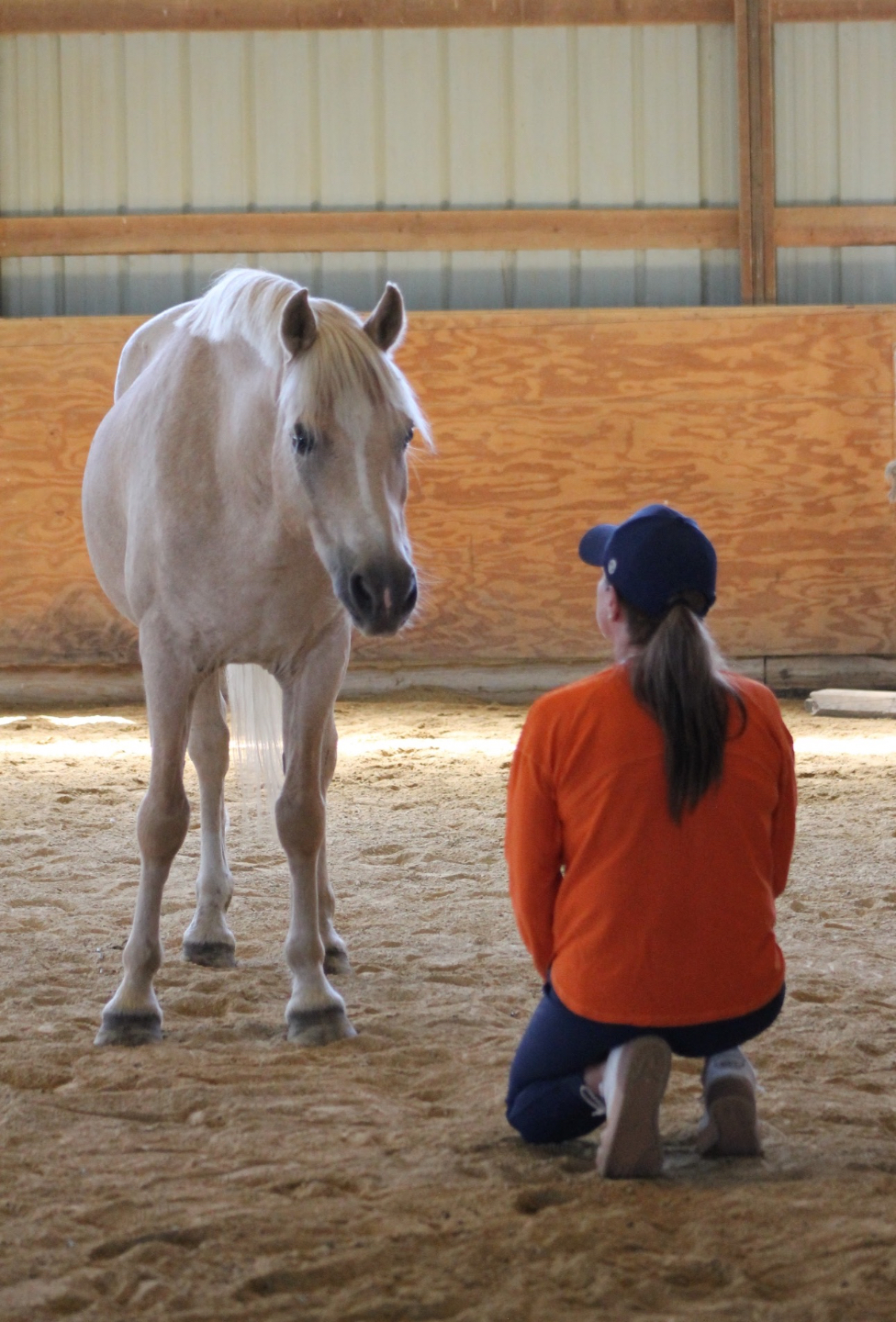
Is Hand-feeding a Problem?

This is always a been a hot topic which brings up some valid concerns. Here is a response posted on The Horse.com. Dr. Sue McDonnell is the founding head of the Equine Behavior Program at the University of Pennsylvania School of Veterinary Medicine. She offers some sagely advice.

Here is a link to the article:  Hand-feeding Treats

I posted this in a group discussion but decided I wanted to share it here as well:  From the article I think it is apparent where I stand on the topic. I want to reiterate that it is not feeding the treats/reward that is causing the problem. It is all about our timing. What were they doing when the treat is delivered? What ever behavior the horse was exhibiting at the time is the behavior will see more of. We have, in effect, said that is what earned you the reward. We are training this behavior.

The mere fact that this hand feeding issue exists supports the effectiveness of positive reinforcement training. Horses, or ponies, are quick to remember what resulted in a reward…even if us humans aren’t making the connection, they are figuring it out. The trick is to learn how to use this incredible motivator for good purposes. To improve performance, motivation, our relationship and to solve problems. I hate to see people throwing out the baby with the bath water. It is not so hard to learn how to use positive reinforcement correctly. However, it is not a part of traditional horse training,,,yet. The behavioral principles are at work whether people are aware of them or not. The more people learn about them the more effective they will be as trainers. All that being said, I would rather not have my horse fed treats by people who were not aware of the relationship between treats and the resulting behavior. I look at any type of reinforcement as a training tool. Would anyone let a child, or adult for that matter, use a riding crop on a horse, all willy-nilly, with no education? Certainly not. I think it is the same with treats. Both reinforcers (the stick and the treats) are changing behavior. I think education is the key

How is Clicker Training Different then “Whoa”?

I try to address Vic’s question regarding positive reinforcement training and training “Whoa”.  It is a basic question and it may be very helpful for those that are unfamiliar with how it all fits together.

QUESTION:  What does your training do that teaching the command “whoa” does not?

RESPONSE:  Hi Vic and thank you for the opportunity to address your question.  The training, which is based in proven behavior principles, teaches a horse so much more than “Whoa” that it is hard to even know where to begin.  I imagine you are talking about the sound of the clicker vs the entire training.  Depending on how it is trained, generally “Whoa” asks them to stop.  While the clicker does end a behavior, more importantly, it tells them they have done something correctly and have earned some sort of a reward.  It is a “Yes” signal.    The click also draws attention to a particular moment in time.  They remember what earns them the click.  So, if I like a canter depart or a flying lead change I can draw attention to that particular action.  I may not be able to deliver a reward at that point in time but I can bookmark that moment in time.  Technically speaking, the sound of the clicker is called a “bridge signal”.  This is because it bridges the moments between the correct behavior and the and the moment when I can deliver a positive reinforcement.   Another example of the clicker at work happened with a women who was teaching her filly to lift her legs.  She had the idea to use carrots as a reinforcement when she was good.  She did not use a bridge signal (the clicker).  Instead she just fed when she was done holding her leg up.  The women reported that her horse seemed to be pulling her leg out of her hand and placing it back on the ground.  I asked what her horse was doing when she got her carrot.  She told me that it was when her leg was back on the ground.  The horse had made the association that her foot back on the ground equals reward.  We fixed the problem by introducing the clicker into the equation.  That way she could click when her foot was in her hand and communicate that this is the behavior that has earned the reward.  I think it is important to note that she was still feeding the filly when her foot was on the ground but she now had a way to communicate which part of that equation she was rewarding.  She quickly and easily changed the behavior.  Better yet, she opened up a new way to communicate with her filly.  I hope this answers your question an clears things up a bit.  If you have more questions please let me know.   This barely scratches the surface.   If you would like to learn more about positive reinforcement training there is a lot more information and even some video sessions on this blog.  A good place to start might be a clip that Rick Lamb did for his television show.  If you are interested you may go to this link:  http://shawnakarrasch.com/blog/2011/11/08/the-horse-show-with-rick-lamb-2/ or enter “Rick Lamb” on the blog’s search bar.

Helping a Foxtrotter, or Any Horse, to Maintain His Gait (and a behavioral review!).

I address Marjorie’s question about maintaining her Foxtrotter’s gait. However, this really applies to any horse having trouble with his gait. One of the things I enjoy most about my position is that I have the opportunity to work with horses and riders from all different disciplines and levels of training. While I may not have expertise in that particular discipline, as a behaviorist, I can still make a difference in the horse’s performance. It all boils down to some basics in behavioral principles. I think this might be a good time for a brief review for those of you who are new to the blog and a reminder for you old pros!

The key is to draw attention (via a reward) to the small steps that are taken to create the behavior. These building blocks are called successive approximations. By recreating this progression of steps we are reminding our horses of the training which led to the final product. Furthermore, by adding positive reinforcement (reward) to the equation, we build a new reinforcement history with the correct behavior. Everything our horses do is because of an association they have established with behavior. An important axiom to keep in mind is: If any behavior increases in frequency, then something in the environment is reinforcing the behavior. This means they are either seeking something they want or avoiding something they don’t want. That is the bottom line. Sounds pretty simple when you think of it that way, don’t you think?

By stepping into any training situation and ramping up the amount of positive reinforcement associated with a task or performance you can modify behavior. A lot of people believe they are using positive reinforcement but true positive reinforcement is something that the horse holds in high regard. Us humans tend to use something we hold in high regard. Primary reinforcers are the most effective. Particularly the things that are required for survival. These primary reinforcers are: food, air, water, sleep and procreation. The first 4 refer to the things needed for the horse to survive as an individual while the 5th, procreation, refers to survival of the species. Since our horses are hard-wired for these things, their power as a motivator is unrivaled by anything else we currently use in our training programs. Food is clearly the easiest to implement and hugely effective. Of course, as I have explained before, there are boundaries to establish and maintain when we utilize food as training tool. Alright, I think that is enough for now. I can go on and on. Heck, I have taught a week long college course so I can talk behavior for a week straight! Understanding these principles is the first step to becoming a better trainer. Let’s watch the video…

Teaching Your Horse to Cross his Legs

I have tended to steer clear of teaching people how to teach their horse to do “tricks”. There are so many practical uses for positive reinforcement that I stay busy teaching people how to address their everyday horse issues. Also, I must admit that I dislike the word “tricks” when referring to training. Tricks are slights of hand and things that fool the observer. These are just behaviors like everything else we teach them to do. These are “just for fun” behaviors. Let’s face it, the horse doesn’t see the difference between a bow and a half pass. One doesn’t make any more sense to them than the other, yet from our perspective there seems to be a world of difference. The relationship we build with our horses is not based on things that horses naturally do in their world. When is the last time you saw a horse saddling up and riding another horse or a horse picking out another horses feet? We establish a rapport with our horses that is unique to us humans. I have found that teaching anything from the ground really enhances our relationship with our horses. Teaching “tricks” through positive reinforcement not only strengthens our bond it stimulates our horses mentally and teaches them how to learn. The last part of that statement may seem like an odd thing to say but horses who have not been exposed to positive reinforcement training have not previously been given the opportunity to make real choices in regards to training. “Trick” training helps to build their confidence and it actually tells you a lot about how your horse processes information. I have taught “tricks” for the sake of demonstrations. I have found that when I ask Mint to back up and the observer watches him back up for 50 yards, or until I ask him to come back to me, it makes a impact. If I were riding him it wouldn’t be as clear as to how much was the use of my aids and how much was really coming from his free choice. His Back-up is not any different than asking for a nice forward canter with a slight bend and having him maintain it without having to remind him, until I ask him to do something else. Having him perform it at liberty, without goading, intimidation or repercussions, demonstrates the horse’s willingness and desire to perform. And finally, let’s face it…it is just plain fun to watch your horse ham it up!

If you would like to see some video of the leg cross or other fun behaviors go to (search) this post on my blog: The Horse Show with Rick Lamb

Haley Loves to Watch TV

January 28, 2012 by  
Filed under On Target Training

Okay, this is a little off topic but I thought you would get a kick out of this video.  My dog, Haley, loves to watch TV. I thought it was a passing fancy but it has been years now. Everyone who sees her do this has said I should get it on video. So here it is, Haley watching TV. She is watching “It’s Me or the Dog”. She tries to interact with the dog on TV. She is very interactive when she watches television. She gets more animated when she sees any animal, whether real or cartoon, also if there is a lot of activity or if she sees someone with facial hair. I hope you enjoy it!

Horse Bucking at the Canter Transition

In this video I address Vicky’s question about her horse who has been bucking when transitioning from trot to canter. I posted this to You Tube back in November. Then the holidays and moving took over my life. So, now I am getting this posted here on my Blog. Often times I film these short clips and realize I have not addressed some important points. I then pair the video up with the written part of the post which will address some of these issue. But I think this one pretty much covers it. However, I did get a question posted on FB the other day that is addressing bucking with the flying lead change. They are slightly different scenarios but the underlying issues are the same, bucking during a transition. I am going to post the question and response so you can get another case scenario. After all, the more information you have the better equipped you will be to think on your feet when an issue arises.

Something to keep in mind…Bucking can also be a way your horse communicates that he is in pain or having discomfort so be sure to eliminate any possible physical causes for this behavior before you address it through training. Once he has a clean bill of health you are ready to proceed. However, let’s say your horse had a physical cause for his bucking. Maybe he had an injury or an ill fitting saddle. So, you do what it takes to remedy the situation. Just because the pain has gone away doesn’t necessarily mean the bucking will go away. He may still remember the pain and associate it with a particular activity and continue to avoid that activity. You will probably still have to address it from a behavioral stand point. That being said, let’s get to Shari and Vicky’s questions.

QUESTION: How do you respond when your horse does something really good, you click, but before you reward him he does something really bad? For example: teaching a flying lead change. He does it perfect for the first time, you click, then he starts bucking. Would you still reward? Would you ignore it all together and try again? Or something else?

ANSWER: Hi Shari, That is a really good question. I would not recommend rewarding him for the behavior. Granted you clicked, which is drawing attention to the target behavior but you don’t want him to inadvertently associate the unwanted behavior with the reward. It could turn into what is called a “superstitious behavior” which means he may think it is part of the whole chain.

I would try to make a mental note of when the unwanted behavior happens. I would look for an opportunity to draw attention to that behavior in another circumstance. For example: go back to the simple change and click when he settles after the change to the new lead. I know he probably doesn’t have a problem with this behavior during the simple change, but it will help to build a reinforcement history with this part of the behavior. We want to teach him that relaxation is an important part of the criteria for reinforcement. This will help him to relax and settle as soon as the change is done since this is when the click/reinforcement happens.

Now, let’s say that he keeps being too excited after the flying change. In that case I would suggest not drawing attention to the actual change itself but instead once he settles after the change.

I hope this helps clear things up a bit. If you have more questions please don’t hesitate. I have some other tools to use under saddle that I will address in the next tele-seminar. It is just too much writing to discuss here! Please keep me posted on your progress.

Horse Slaughter?

November 29, 2011 by  
Filed under On Target Training

In US many of us are comtemplating the ramifications of legalized horse slaughter since our government has re-opened the door. I know horse people fall on both sides of this emotional debate. Some say how could that possibly be okay, these are our family members? Others say what makes a cow different then a horse? Who are we to say it is okay for one species and not another? What about all the horses left to suffer and starve to death? Which ever way you lean I think there are some real issues with the tactics that are used to transport the horses to slaughter as well as the slaughter process itself. These protocols were established for cattle. Cattle are anatomically different then horses and this means that what works for cattle doesn’t necessarily work for horses. Transportation has always posed a problem. With only a few slaughter houses in the US there is usually a long journey. There were severe welfare problems associated with shipping the horses to slaugter here in the US back when it was a legal practice. Horses were routinely shipped for 24 hours and the injuries were substantial (the gruesome pictures in the Forbes article were from the Texas slaughter operation back in 2005) I don’t want to see any animal standing around with a compound fracture or with both eyes gouged out. It seems there should be some regulations to prevent this unnecessary suffering. Other animals intended for slaughter, cows and pigs for example, do not sustain these injuries.

As I understand it, the only reason there is no slaughtering horses for human consumption going on right now is because the inspections were “de-funded”. It is illegal to transport meat out of the US without the USDA inspection process. I don’t think any bill actually passed that made it illegal to slaughter for human consumption, although many were proposed. Now that the inspections are back in force things will most likely get rolling again. The horse meat exporters prefer to have the healthy, fit horses vs the feeble and un-muscled.

I think this is a topic that people are quite passionate about. I think it is important to be aware of the facts and objectively weigh the pros and cons. I am by no means an expert on the subject and there are many things to consider. I think if we want to stand up and be heard, the time is now and we better start educating ourselves. I found this article interesting (link below) and I must warn you that if you chose to click through to the picture link (on 2nd page) there are some photos that are not for the faint hearted.

My Bugs, who is a really special, lovely horse with lots of personality, could very well have landed in a kill pen. He was started late, he wasn’t adapting well to his training. He was off to the sale. I understand he was pretty difficult and suspicious at that point in his life. He was not fit or filled out and he had a scar on his face (from the trailer? The bucking chute? That part is not too clear). I don’t think too many people would have taken a chance on him. Thank goodness for Marcy who decided to give him a break. When I read the horrible stories and see the pictures of horse going off to slaughter I remember that Bugs could have had a very different fate. He is a source of joy for me. I call him Love Bug!! When I think about his plight I react very emotionally about the topic of slaughter. This sentiment is not practical or realistic when it comes to being objective so I struggle to find some balance. What are your thoughts on this issue?

Click here: Forbes: Racing Industry Silent About Slaughtered Thoroughbreds

Teaching a Foal: Starting Them off Right

Stephanie posted a question about her colt. When to start training and behaviors to work on to prepare him for adulthood. I, as usual, have a ton of ideas and I am know I am just scratching the surface!

QUESTION:

Hi Shawna,
I’ve just purchased your Despooking DVD’s & am excitedly pouring over them. As yet I have not used clicker training with any of my horses although I have fun playing with it with my rescue dog. My 2 questions are , at what age can a horse be introduced to clicker training as we have now have a7 day old colt & what are some examples of uses for a youngster?

RESPONSE:

Congratulations Stephanie! What an exciting time for you!

I am a big proponent of handling them from the moment they are born. There is a lot of conditioning that will help them to get comfortable with people. However, I start a positive reinforcement training plan as soon as they are weaned. After Bridge (clicker) conditioning and target training I teach them to lead. I tend to start with the target so they get the concept to stay with you. Stop when you stop, turn when you turn, etc. Then, I introduce the the halter and lead rope and teach them how to respond to the pressure. You can also incorporate the target at this point so it helps them to know what to do instead of the resistance/fear that most babies exhibit. I teach them anything they may need to do as an adult. Certainly teach him to accept being touched everywhere including the sheath, ears and mouth. You can teach him to accept oral syringes (wormers). Lifting his legs and letting you move his feet to and fro. Prep him for the things they farrier will eventually be doing. You can do de-spooking work with tarps, bridges…whatever you can think of to expose him to. Teach him to soak his foot in a bucket of water. You can teach him to put his head in the halter. This concept carries over to the bridle/ bit when the time comes. You can teach him to be clipped and trailer load. You can teach him to walk with a saddle pad secured with a surcingle. This helps with blanketing and certainly saddling later. The more consistent you can be the better. It would be good to teach him to be comfortable away from other horses and to be in a stall. I know there will be periods of time that his training will take a back burner while he is growing but if you can, set a bit of a schedule for him to have some training exercises on a consistant basis.

The best part of a baby is you can plan ahead and circumvent a lot of issues that tend to come up in adulthood. You may not have a need to do a lot of these tasks yet (clipping, soaking his foot, trailer loading etc). However, teaching him these things now will pave the way for him to progress seamlessly down the road. I also recommend keeping some sort of journal so you can keep track of what he has learned, how he responded. As time passes you may forget some of the details.

These things all serve a practical purpose but they also set him up for a lifetime of learning. You are going to find that he enjoys learning and he will learn much faster then the horses who were not trained with positive reinforcement. He will be more sensible mature(mentally) beyond his years.

I have found that the babies are not too spooky when they are young. They are just full of curiosity and they don’t seem to know enough to be fearful yet. This is a big bonus for the training process. They seem to go through a more reactive phase between one and two years of age. If you play your cards right he will sail right through this without letting spookiness get a foothold. Granted he will still startle at things but his reaction will be minimal.

Keep in mind babies have a lot of energy. Teaching him to be patient and still is harder for the rambunctious little horses. I incorporate some retrieving and targeting further away between the standing still type behaviors. This willl give him an outlet that you get to initiate. They can run after a ball a few times and expend some energy in a safe and controlled manner. It is a reinforcement for them and helps to set them up for success when you get back to standing still. Because you initiated the behavior it strengthens your relationship. This will help to keep his attention from wavering. Start with short sessions. Their attention span is short at first. You can build up the time in between and pretty soon he will be able to stand patiently for long periods of time.

Another thing to keep in mind is they learn quite a bit vicariously. This means he will learn socially, by watching the others around him. His biggest role model is going to be his mom. Things that mom does well, I would make a point of exposing him to on regular basis while he is young and soaking up mom’s reactions . If she is good with clipping expose him to her being clipped (or just the body of the clipper touching as if you were clipping). The more you can do the better. He will emulate her reactions to everything. Including how she reacts when people are around and when they approach her in the pasture. If there are things that she is not so good at, I suggest you try to minimize his exposure to those things.

This is important too! Don’t forget he will also need healthy boundaries as he grows. Babies (both equine and human!) like to test their world and everything in it. I have found if you give him lots of time to play and be a horse he will learn to keep that play for his social situations and not with you. Babies are cute. The ornery little things that they do when they are young are often overlooked or excused because they are such cute little guys. They are learning right away. Young horses are hard wired to play and learn the skills that they will need as adults. This means sparring with one another. It is reinforcing for them. At some point he may try to engage you in this game. Do not fall pray to this by reacting and sparring with him.

I got a little horse who was weaned at four months. At less then five months old he went and did his first clinic with the big horses. He was too small to cross tie so we had to push tack trunks in front of standing stall. He just curled up on the floor and slept! He came right out of the trailer at the clinic with no halter, went right to the ring and stayed with me the whole time. He couldn’t have been cuter.

Okay those are some ideas and food for thought. I certainly don’t have all the answers but I hope this helps you out a bit. Please don’t forget I am here if you ever want some input. What an exciting journey that lies ahead of you! :0)

A Thought About Tom Dorrance

November 18, 2011 by  
Filed under On Target Training

I posted this comment about Tom Dorrance in a group discussion but thought I would share it here too. He was a man who influenced many a horse trainer!

When I was still at Sea World and looking into horse training and realized it was WAY different than what I knew as animal training, I read an article about a man named Tom Dorrance.

I hadn’t started riding yet. I was still researching the subject. I couldn’t figure out why no one in the horse world was using positive reinforcement. So, I called this man. We talked on the phone for a while about horses and marine mammal training. Tom was quite open to the idea of incorporating positive reinforcement into horse training. He invited me to come to his farm. He sent me a signed copy of his book True Unity. I was still just looking and trying to figure things out. I was entrenched in my Sea World career so I didn’t take him up on his offer. I didn’t really know much about the man or the cowboy mentality at the time but he was never condescending or dismissive. He was soft, kind and open to a new method. He certainly didn’t fit the stereo type. It doesn’t seem to me that the trainers that have studied under him have that same quality about them that I heard on the phone. Tom was unique. He really seemed to be a gentle soul who cared about the horse’s well being. If there was possibly a better way to train a horse, he was eager to learn about it with an open mind. I applaud his spirit.

Flying Lead Changes and Verbal Cues for Horses

This letter was forwarded to me by my friend Jane (Savoie) who is a big advocate of positive reinforcement/clicker training. We go way back and she knows how much I enjoy helping people to embrace clicker training.

Hi Jane,

I have listened to all of the audios on the Dressage Mentor site and they are fantastically helpful. In a couple of them, you mentioned clicker training and instances in which you used clicker training help horses get used to clippers, perform square halts, etc.

Hearing you talk about clicker training inspired me to try it with my horses. Thanks to clicker training, they now look away from a treat on command and can “talk” on command. I even am using clicker training in groundwork to help one of my horses learn how to perform a correct turn on the haunches.

I also have been getting my trainer to use the clicker to train me while we work on the timing of my aids, my position, etc. I think that it is helping me a lot!

I was wondering if you could share more advice about clicker training in general and if you had any advice or thoughts about how to use clicker training to help a horse learn how to do flying lead changes.

In the case of using clicker training for flying lead changes, do you think a horse could learn commands that instruct them to move their bodies in very specific ways (such as the command “left” to bring their left hind leg under them to switch to a new lead)? Or “switch” to switch leads?

Thanks so much for all the wonderful information that you share–every time I read your articles or listen to your audios I feel that you have given me a beautiful gift! I truly appreciate it so much.

Sincerely,

Tammy

MY RESPONSE:

Hi Tammy,

I am so excited for you getting familiar with clicker training. A big thank you to Jane for introducing you! As it sounds like, you have discovered that it helps to change the relationship between horse and human. I also love that you have started taking it to other areas of training. Positive reinforcement training is something that I am passionate about. It can be used for teaching horses to do just about anything within their physical capacity. That in itself is pretty exciting and the possibilities seem to be endless. I am not sure what general questions you might have but if you let me know I will be glad to address them. If you want more info please feel free to go to my website. My Blog also covers a lot of areas. The Blog has a search bar which makes it easier to find particular topics or you can scroll through and see what strikes your fancy.

Okay let’s get down to flying lead changes. Positive reinforcement can be used with any behavior we want to teach our horses and this of course includes flying lead changes. You may follow traditional methods simply adding in the positive reinforcement or you can think completely outside the box or you may utilize a combination of the two. That is really your choice. My expertise is not in the steps to take to achieve the lead change but in breaking down the process and adding in the positive reinforcement. You have some great ideas and you are on the right track. One place I tend to start is with the simple change (I ride with a waist pack and a clicker attached to a riding stick). I click and reinforce (C/R) at the point when he has switched to the new lead. This helps to draw attention to this behavior as well as to build up a good reinforcement history associated with the change. One caveat, I would C/R once he feels relaxed with the new change. If he feels too revved up, I wait for him to settle into the canter. Since many horses get a little wound up when they are learning changes I want to teach relaxation with the behavior. I also suggest clicking and reinforcing all of the behaviors that prepare them for changes. Counter canter, counter bend, haunches in, haunches out and collection would all help to get him responsive to switching his balance and preparing for changes. Balancing out the reinforcement between all elements of the change helps them to stay focused and on track. This is a huge help. It takes some of the arbitrariness out of the equation. Sometimes when they are getting started it takes a big effort for them to shift their weight. Once they gain their confidence their changes usually get much smoother. I will C/R the first few changes as soon as the change is complete (no cross cantering). Then I shift to clicking once when they are settled after the change. This helps them to realize that the quicker I settle the sooner I may get feed. This helps the changes to get smoother faster. Once your horse is solid with his changes it is time to build the duration.

You can definitely work with verbal cues to accompany your aids or just on their own. Something to keep in mind as you start to use verbal signals, you want to choose words that don’t sound alike. For instance, sit down and lie down may sound very similar to a dog and this makes it hard for them to distinguish between the two. Since he is already under saddle with traditional aids you might want to use the language that he understands (aids), paired with his new signals (verbal) to get started. It is a great tool for helping things to be clear, thereby, helping to set him up for success. I would begin to teach him some verbal cues with something like lungeing. I assume he knows how to lunge and that it was taught through traditional training (if not, that will be a different conversation and may also be taught through positive reinforcement). I like to teach “walk”, “trot”, “canter”, “whoa” and “back up” on the lunge line or in a round pen. You are certainly not limited to these signals as this is just an example. This gets him used to the practice of listening to verbal signals related to the gaits and helps to set him up for success when you move to under saddle. I would ask him to walk saying the verbal signal just a moment before you ask him to move forward to the walk using the signal he already knows. C/R his correct responses. He will begin to put it together pretty quickly. By putting something in it that he values, he becomes invested in the training process and it’s outcome. Next, move to the other gaits. Change it up a bit to be certain that he is listening to your words. Also, don’t overlook the value of standing quietly. There is a tendency to focus on action and forget to balance out the behaviors with being quiet and relaxed between activities. When all is good and solid at this level it is time to go under saddle. Once under saddle I suggest you start introducing the verbal cue just before you use your aids. This will help him to begin to pair the verbal with the appropriate action. You should feel when he starts to respond to the verbal cues and this allows you to start fading the use of the traditional aids. You could add the intermediate step of having a rider getting on and having him respond to the verbals given by you and being able to support him from the ground since this is most familiar at this point. Then you switch the control/focus to the rider. However, I have found it usually translates pretty seamlessly and the extra step isn’t necessary.

To answer your question, yes, you can teach him to move a particular foot underneath himself. If you want to go this direction, I encourage you to start this on the ground and remember to C/R through out the process, break it down to small steps, do “short and sweet” sessions and do what you can to set him up for success. First at the stand still, to isolate the movement you are looking for, then I would begin to work it at the walk. When the behavior is where you would like it to be and he is consistently responding correctly I would get someone to be in the saddle and you on the ground. You will be offering support form the ground by being able to take a step back in the training be applying the steps that helped him to learn it in the first place. This will help make it clear for him and to his minimize his potential for frustration. He may be a little confused at first since he may not be sure who to listen to. First it should be you, ask him to perform the behavior as he normally does, basically ignoring the rider to start. When he has that worked out, I recommend you begin to introduce the under saddle signal whether it is verbal, physical or both. You should do this by using the new under saddle signal, promptly followed by the established signal from the ground. When he responds correctly I would suggest you reinforce from the ground the first couple of times. When you feel like he is listening to the rider consistently then it is time to fade the ground person out of the equation and have the rider do the reinforcing from horseback. When he is clearly understanding this at the walk, it is time to introduce higher gaits, starting slow and only moving up as he understands the concept at the previous gait.

These are some ideas and guidelines but by no means the only way or the only answer. There are so many options it can make my head spin! Also with individual personalities, sometimes the training process moves a little differently than you anticipated, be flexible. I hope this gave you some ideas and answered some of your questions. If you have more questions or want some help as you move along, please do not hesitate to ask. I love your creative thinking and look forward to hearing from you as you progress.

Warm wishes,

Shawna

On Target Training, Shawna Karrasch

© Copyright 2010 On Target Training. All Rights Reserved.